




Canada's Historic Housing of Black Refugees During Slavery
Celebrating Welcome Place's 80th Anniversary
Canada holds a long history of housing refugees and asylum seekers. In honor of Black History Month, we would like to highlight the times Canada was a refuge and new start for those escaping the oppressive reign of slavery in the United States. With the aid of slave abolitionist groups, slave refugees would go on to build sustainable lives in Canada, creating new occupations, opportunities, and communities that strengthened Canada’s ecosystem.
Celebrating 80 Years of Welcome and Community
As we mark 80 years of Welcome Place (MIIC), we celebrate the incredible journey that has shaped who we are today. Since 1945, we’ve been honoured to welcome and support refugees and newcomers seeking safety, belonging, and hope in Manitoba.
Over the decades, together we’ve:
- Helped thousands of newcomers build new lives through settlement, sponsorship, and life-skills programs.
- Expanded our reach across Manitoba, fostering inclusion in both urban and rural communities.
- Built partnerships, volunteer networks, and initiatives rooted in compassion, respect, and equity.
This milestone belongs to our community—to every staff member, volunteer, sponsor, partner, and newcomer who has been part of our story. Your kindness, resilience, and commitment have made Welcome Place what it is today.
As we look to the future, our promise remains: to continue creating a province where everyone feels safe, supported, and at home.
Thank you for 80 years of welcome—and for shaping a stronger, more compassionate Manitoba.
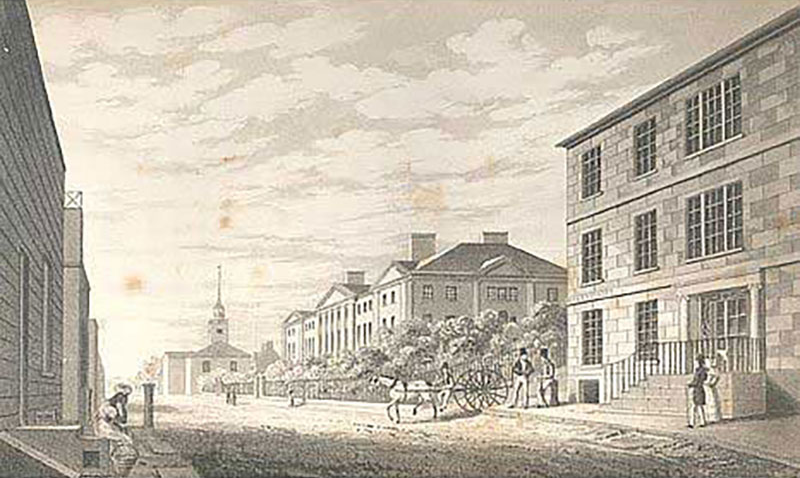
Earliest Documentation of Settlers and Refugees
The earliest documentation of Black Settlers in Canada dates to Pre-Loyalist Settlers in the 1600s. These individuals were mainly of African descent who were displaced as slaves and would go on to settle in Nova Scotian communities.
Afterwards came the Black Loyalists in 1783. This was a result of the American Revolutionary War. Many enslaved Black people were promised freedom and land in return for supporting the British. Over 3,000 Black Loyalists settled in Nova Scotia, becoming one of the largest migrations of free Black people to Canada.
In 1796, A group of 550 Maroons, exiled from Jamaica after resisting British colonial rule, were resettled in Nova Scotia.
Lastly, thousands of Black Refugees from the war of 1812 were granted passage to Nova Scotia between 1812-1816, looking for freedom from slavery in America.
Establishment of Black Communities
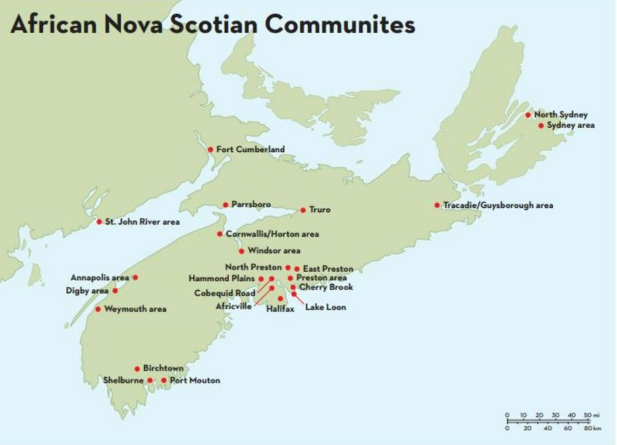
The arrival of these settlers, maroons, and refugees brought about the creation of fifty-two historic Black Settlements. The settlements most notably founded/co-founded by Black Refugees (and their descendants) include:
- Mulgrave Road (Guysborough County)
- Mount Uniacke
- Upper Big Tracadie
- North Preston
- Lucasville
- Five Mile Plains
- and Africville.
The expansive list of other settlements can be found here The Original Black Communities in Nova Scotia – 902 Man Up
The Slave Refugee Friends Society
A key factor in the successful relocation of Slave refugees were abolitionist groups. One of these groups were known as The Slave Refugee Friends Society. It was formed in 1852 by abolitionist groups in St. Catharines, Ontario (came about after the abolition of slavery in Canada in 1833). They organized financial support, employment opportunities, shelter, food, clothing, education, and healthcare for refugees arriving in St. Catharines, escaping American enslavement.
Key Members included William Hamilton Merritt, Member of Parliament for St. Catharines and Mayor Elias Smith Adams. Jermain Loguen, who was a station master at Syracuse, was made a member and benefited from assistance organized by the group. Harriet Tubman was additionally made an honorary member during her stay in the city.
Slave Refugees & Transferrable Skills
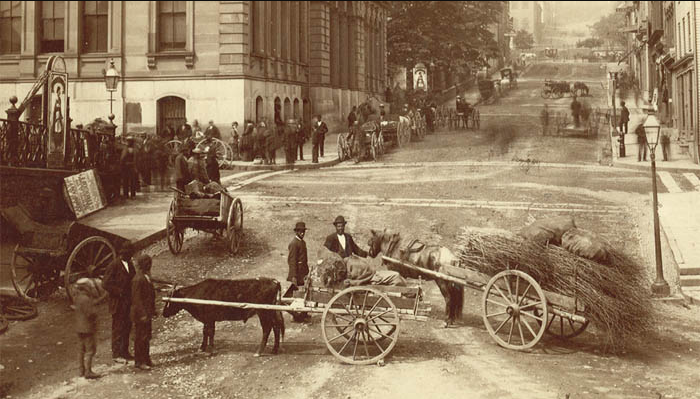
While groups like The Slave Refugee Friends Society were able to ensure refugees were given the education slavers deprived them of, that did not mean they came here with no direction. They all had survival-induced skills that could be used to gain employment. Former slaves who had trade skills (carpentry, blacksmithing, barbering), for example, were able to find work in small towns/cities.
Black men were able to get jobs on the railroad, earning income for clothing their families and purchasing land. Black women who were maids, dressmakers, laundresses, and cooks were all able to use their acquired skills to gain employment.
In other cases, their survival skills were used to create entirely new opportunities for self-employment/independence. Many former slaves were proficient in hunting, fishing, gardening, and raising livestock, as they were all means of self-sustenance due to being underfed by slavers. This skillset development was transferrable when they arrived in Canada. This allowed them to grow cash crops such as wheat, potatoes, vegetables, fruits, and tobacco to sell for independent income.
What This Shows
Canada’s intake of refugees is nothing new. The country has historically been a refuge for those escaping persecution, predating treaty obligations to respect, protect, and fulfill the rights of refugees and asylum-seekers by over three hundred years. (Particularly Article 14.1 of the Universal Declaration of Human Rights, which covers that everyone has the right to seek and to enjoy in other countries asylum from persecution).
It also demonstrates the resilience and adaptability of slave refugees. They contribute positively to Canada’s ecosystem; creating their own cultural impact in building communities, opportunities, and means of sustainability with previously obtained survival skills and the aid of abolitionist groups despite facing oppressive rule and racial barriers.
Welcome Place Continues to Build Community and Engage with Newcomers
It takes community support from those with varying levels of power and privilege to initiate progress and development. The extra aid from abolitionist groups to finance, house, educate, and feed Black slave refugees in their early arrival made transitioning to life in Canada more efficient.
In the modern day, Welcome Place continues to aid refugee claimants fleeing persecution of varying degrees. Our mission is to make it easier for refugees to succeed when they arrive here in Manitoba. We strive to:
- Help newcomers and refugees adjust to life in Canada.
- Ensure newcomers and refugees are aware of and can access necessary and appropriate settlement services.
- Develop comprehensive and enriching programs to familiarize newcomers and refugees with the skills needed for daily life in Canada.
- Assist newcomers and refugees to find permanent accommodations.
- Empower newcomers and refugees to contribute to the community.
- Mobilize resources from government, like agencies and the general community, that will help newcomers and refugees settle into Canadian society.
- Mobilize resources from government, like agencies and the general community, that will help newcomers and refugees settle into Canadian society.
- Monitor government policies and attitudes to newcomers and refugees and to work cooperatively with federal, provincial, and non-government agencies which are concerned for their welfare.
- Speak to Social Justice issues related to newcomers and advocate on their behalf as need arises
- To forge partnership between newcomers and refugees and the community through shared learning and mutual understanding, to obtain harmonious unity.
Welcome Place exists to foster dignity, independence, and compassion in the lives of people who have come to Canada as refugees. We support equitable treatment of all persons and embrace cross-cultural differences. We welcome all without bias. Our relationships are based on mutual trust and respect.
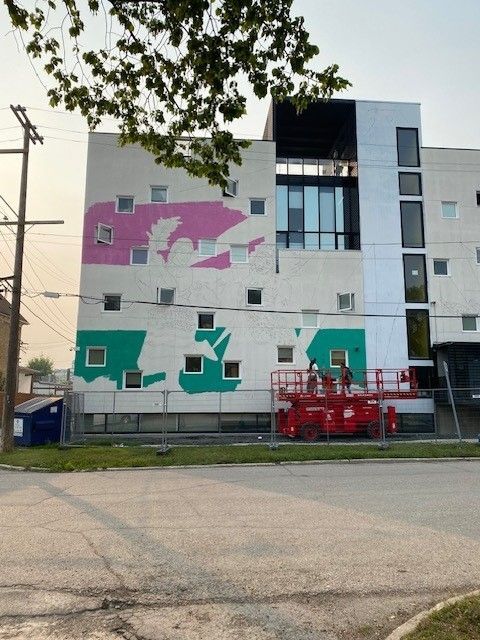
Dance Your Way Mural
Dance Your Way is a five-story mural by newcomer artist Bîstyek and Indigenous artist Jeannie White Bird, commissioned by Welcome Place to celebrate its 80th anniversary. The artwork honours eight decades of supporting refugees and newcomers, rooted in the ancestral lands of Treaty 1 Territory.
At its heart, two figures — an Indigenous jingle dress dancer and a Kurdish newcomer — dance together, symbolizing reconciliation, resilience, and shared healing. The exchange of sweetgrass and an olive branch reflects kindness and peace, bridging the experiences of Indigenous and newcomer communities.
Surrounding them are sacred symbols of strength and renewal:
- Thunderbird, protector and watcher over all
- Turtle, spirit of Turtle Island and healing waters
- Four Direction Star, honouring life’s cycles and humanity’s unity
- Grandmother Moon, guiding from above
- Flowing wires, representing movement and empowerment
The word “Welcome” appears in over a dozen languages spoken by newcomer families — celebrating language, identity, and belonging.
With its vibrant colours and powerful imagery, Dance Your Way stands as both a celebration of community and a living act of reconciliation, weaving together stories of displacement, strength, and hope for a more connected future.
