




Canada's Relations to Asian Refugees
Celebrating Welcome Place's 80th Anniversary
In commemoration of AAPI Heritage Month, let us look at how Canada has fostered refugees from the Asian diaspora. With Asian refugees came new acts and legislations. The drafted 1976 Immigration Act (going into effect in 1978), for example, illustrated for the first time Canada’s immigration policies. This included Canada’s main objectives to fulfil its international legal obligations with respect to refugees and to uphold its humanitarian tradition with respect to the displaced and the persecuted. Furthermore, this was also the first piece of Canadian legislation to formally recognize refugees as a special class of immigrants. Since then, Canada continues to be a host country for many refugees of all backgrounds fleeing persecution in their own place of origin. Canada additionally provides international aid to refugees who are not settling within Canada.
Celebrating 80 Years of Welcome and Community
As we mark 80 years of Welcome Place (MIIC), we celebrate the incredible journey that has shaped who we are today. Since 1945, we’ve been honoured to welcome and support refugees and newcomers seeking safety, belonging, and hope in Manitoba.
Over the decades, together we’ve:
- Helped thousands of newcomers build new lives through settlement, sponsorship, and life-skills programs.
- Expanded our reach across Manitoba, fostering inclusion in both urban and rural communities.
- Built partnerships, volunteer networks, and initiatives rooted in compassion, respect, and equity.
This milestone belongs to our community—to every staff member, volunteer, sponsor, partner, and newcomer who has been part of our story. Your kindness, resilience, and commitment have made Welcome Place what it is today.
As we look to the future, our promise remains: to continue creating a province where everyone feels safe, supported, and at home.
Thank you for 80 years of welcome—and for shaping a stronger, more compassionate Manitoba.
RECOGNIZING CANADA’S EFFORTS IN HOSTING AND RESETTLING REFUGEES
Between 1979-1980, Canada accepted more refugees per capita than any other host/resettlement country at that time (60,000 refugees), with this intake being the largest single influx of refugees in a short time span. Canada’s vast intake of Southeast Asian Refugees in particular prompted the United Nations High Commissioner of Refugees (UNHCR) to present The People of Canada with the Nansen Medal in 1986 to recognize the country internationally for its dedication to refugee resettlement. This marks the only time a collective population has been awarded this honor/level of recognition
UGANDAN ASIAN REFUGEES
Between 1972-74, Canada welcomed almost 8,000 refugees of South Asian descent (particularly from India, Bangladesh, and Pakistan) from Uganda. South Asians started coming to Uganda while the country was under British rule in 1894. They initially came as laborers for the railroad being constructed there but eventually branched out to traders who supplied exotic goods such as tea, coffee, cotton, and sugar. The British subsequently began relying on the Asian population to expand their colonial rule in Uganda, stoking the racial/ethnic tensions between the Asian and African populations in the process by putting holding the Asian population in higher favor/regard than the Indigenous African population.
Uganda would go on to gain their independence from the British in 1962. A change in government in 1971 set the tone for change in the country. The new administration ordered the review of citizenship status for all Asian Ugandans, along with a census of Asians living in the country. Soon after this, it was announced that the British would need to take responsibility for all the Asian people living in Uganda as they contributed to damaging the economy for African people. On August 9th, 1972, it was announced that the Asian populations were to be expelled from the country, which resulted in approximately 10,000 Asian Ugandans becoming stateless persons. At this time, the British had taken in 50,000 Indian refugees and thus had to call on Canada for additional aid.
Canada initially brought in 5,000 refugees from Uganda but would later go on to bring in over 3,000 more. With the assistance of Ugandan Asian Committees, refugees made their new lives across the country, including areas like Toronto, Montreal, Ottawa, Vancouver, Victoria, Edmonton, Regina, Winnipeg, Hamilton, Halifax, and Windsor. Ugandan Asian refugees brought with them professional and business skills, which made it easier for them to adapt to their new lives in Canada upon their arrival and have since made foundational roots in the country
CHINESE REFUGEES
China faced famine between 1959-61 due to the ruling communist leader’s policy which displaced farmers from their land and forced them to live on communes of agricultural and industrial nature. This, in combination with harsh weather causing crops to wither and deplete, led to the starvation of thirty million citizens. Many Chinese people fled to neighboring regions controlled by the British at the time, and once the British began to feel overwhelmed with the volume of refugees they were taking on, they asked Canada for assistance.
This was a controversial time for Canada. In 1923 they had passed the
Chinese Exclusion Act, which was used to ban Chinese immigration to the country. It was repealed in 1947; however, many Canadians still held anti-communism sentiments and therefore feared that letting more Chinese people into the country would lead to a rise in communism. Despite this, in 1962, the acting prime minister accepted one hundred refugee families from China.
VIETNAMESE REFUGEES
Between 1979-80, Canada welcomed 60,000 Southeast Asian Refugees. The volume of refugees can be accredited to the collaboration between government assisted programs and private sponsorship. For every privately sponsored refugee family, the government would match that amount by also sponsoring a family, which in turn led to the majority of Southeast Asian Refugees being brought to Canada under private sponsorship.
There were two different waves of Vietnamese Refugees. They are as follows:
The first wave arrived in Canada in 1975-78, receiving 7,700 migrants. This wave mainly consisted of well-educated professionals, middle class, supporters of The United States and South Vietnamese governments, and were largely of Vietnamese ethnic origin. Over half of this population settled in Montreal.
The second wave of refugees are refugees who arrived after 1978. Some were relatives of first wave refugees who followed their family over once they had established themselves. The others, while they were coming from Vietnam, they were ethnically Chinese; having lineages who settled in Vietnam many generations ago. Their refugee status was due to an escalating war between Vietnam and China at the time (also known as The Sino-Vietnamese War). Their socioeconomic status differed from those of the first wave refugees, and many of them would go on to settle in cities of Toronto and Vancouver.
The vast majority of the refugees came from 1979-80. Initially, the newer wave of refugees struggled in comparison to first wave refugees who came before them due to the inability to speak either English or French. To overcome this challenge, Canada’s government implemented language programs to provide specialized aid to refugees who did not speak the national language(s), which helped many refugees adjust and adapt to life in Canada. Success among Vietnamese refugees within the country was greatly aided by private sponsorship. Studies have shown that, in comparison to government sponsored refugees, privately sponsored refugees have better outcomes when it comes to employment, being able to speak the host country’s language, and experiencing better health overall. This is due to the pre-established sense of personalization and community that privately sponsored refugees are met with, with friendships and connections lasting well after the sponsorship period has ended.
Aid for Asian Refugees in the Modern Day – The Rohingya
Today, Canada still provides aid for Asian refugees, even when they are not taking refuge within the country’s borders. One example of this is Myanmar. Myanmar has long faced conflict in its country due to political disputes, as well as ethnic and religious discrimination. A more in-depth explanation of the ongoing conflict can be found
here. This, as a result, has created a large displacement and refugee crisis amongst
the Rohingya people, who are a religious and ethnic minority within Myanmar. As of January 2026, over 1 million Rohingya have fled to and now reside in Bangladesh, with others fleeing to Malaysia, Thailand, India, and Indonesia, while approximately 4 million remain as internally displaced persons (IDPs).
While Canada is not a primary host country for the Rohingya people (in that we do not take in the same volume of refugees as other countries in the surrounding area), we still have Canadian organizations assisting those expereicing statelessness. The Canada-Myanmar Refugee Resettlement & Repatriation Foundation (CMRRRF), for example, are providing humanitarian aid for stateless persons, refugees, and IDPs. This NGO focuses on providing IDPs and refugees with legal aid to protect and educate women, girls, and children in IDP camps, helping victims of torture and sexual violence to seek justice in Myanmar courts, and helping reconciliation among ethnic groups in Myanmar to build condition for the returning of refugees and stateless persons to their homeland. Additionally, they help refugees to resettle in third countries (i.e. Canada) by Sponsoring and Liaising with other local Private Sponsors, as well as provide support for integrating Myanmar refugees and asylum seekers into the local Canadian communities.
Canada continues to support human rights monitoring in collecting evidence and holding the perpetrators of serious human rights violations/international crimes accountable through varying international courts/bodies, including the Independent Investigative Mechanism for Myanmar, the International Criminal Court (ICC) and the International Court of Justice (ICJ). In 2023: Canada, along with Germany, Denmark, France, The UK, and The Netherlands filed a
joint
declaration of intervention at the ICJ regarding The Gambia against Myanmar, alleging violations of the Genocide Convention (particular concerning sexual and gender-based violence).
As a result of Canada’s collaborative aid in Myanmar, between 2021-2024:
- 184,463 medical cases for marginalized, conflict-affected, and ethnic minority people, managed by primary health care providers
- 268,229 young people (166,302 women) reached with adolescent sexual reproductive health and rights education
- 122,510 children (51% girls) affected by conflict received psychosocial support
- 183,255 people were reached with nutrition education and services to address malnutrition
- Over 9,900 adolescent girls empowered through leadership training, sports programs, and phone outreach and counselling
- 10 women’s rights organizations enabled to deliver services to women and girls in hostile environment
- 141,788 migrant workers were informed about safe migration, gained new skills (e.g., sewing and tailoring, and mechanical and electrical repairs), and received emergency assistance
- 2.6 million people, 91% of which are women, continued to access savings and loans from micro-finance institutions for their agriculture livelihoods and small businesses
- 51 fellowships and scholarships offered to young scholars from Myanmar (19 women and 15 [young scholars] from ethnic minority groups, including the Rohingya)
- 2,638 pro-democracy actors (e.g., human rights defenders and peace advocates), including 1,283 women, trained in gender equality and federalism
- Canada is the second largest donor providing extra-budgetary support to the Independent Investigative Mechanism for Myanmar (IIMM). Canada’s funding is supporting the collection of evidence of the most serious crimes and violations of international law and preparation of files for criminal prosecution
- 8 rounds of sanctions levelled against the military regime since the 2021 coup (134 individuals, 88 entities and the sector prohibition on aviation fuel)
- 104 citizen journalists and keys influencers trained resulting in increased knowledge of these participants on advanced mobile journalism
- Young women leaders were able to prepare radio scripts and coordinate the production of a radio program, raising awareness on human trafficking, child marriage, and gender-based violence to close to 100,000 listeners from host and Rohingya communities
- 297 young women leaders and male gender equality allies from Myanmar and Bangladesh trained to reduce tensions between host communities and refugees
The commitment to addressing human rights violations allows for the repatriation of refugees in crisis, not just in Myanmar, but across the globe. Championing the respect, protection, and fulfilment of human rights obligations on an international scale ensures global coverage of
progressive realization.
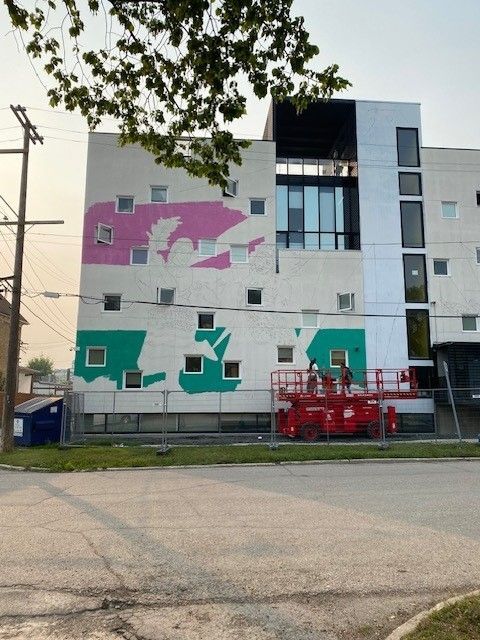
Dance Your Way Mural
Dance Your Way is a five-story mural by newcomer artist Bîstyek and Indigenous artist Jeannie White Bird, commissioned by Welcome Place to celebrate its 80th anniversary. The artwork honours eight decades of supporting refugees and newcomers, rooted in the ancestral lands of Treaty 1 Territory.
At its heart, two figures — an Indigenous jingle dress dancer and a Kurdish newcomer — dance together, symbolizing reconciliation, resilience, and shared healing. The exchange of sweetgrass and an olive branch reflects kindness and peace, bridging the experiences of Indigenous and newcomer communities.
Surrounding them are sacred symbols of strength and renewal:
- Thunderbird, protector and watcher over all
- Turtle, spirit of Turtle Island and healing waters
- Four Direction Star, honouring life’s cycles and humanity’s unity
- Grandmother Moon, guiding from above
- Flowing wires, representing movement and empowerment
The word “Welcome” appears in over a dozen languages spoken by newcomer families — celebrating language, identity, and belonging.
With its vibrant colours and powerful imagery, Dance Your Way stands as both a celebration of community and a living act of reconciliation, weaving together stories of displacement, strength, and hope for a more connected future.
